En
En  Sv
SvDeepening
Ohms Lag
Skyllermarks has always provided information about what you, as a boat owner, can get if you look after your electrical system. We often talk about what to do and what you get, but not how it works. We’re going to review some high school physics for anyone wondering why you might get a double charge.
Very briefly, we can refer it all to Ohm’s law, but without a further explanation, no one will be happier.
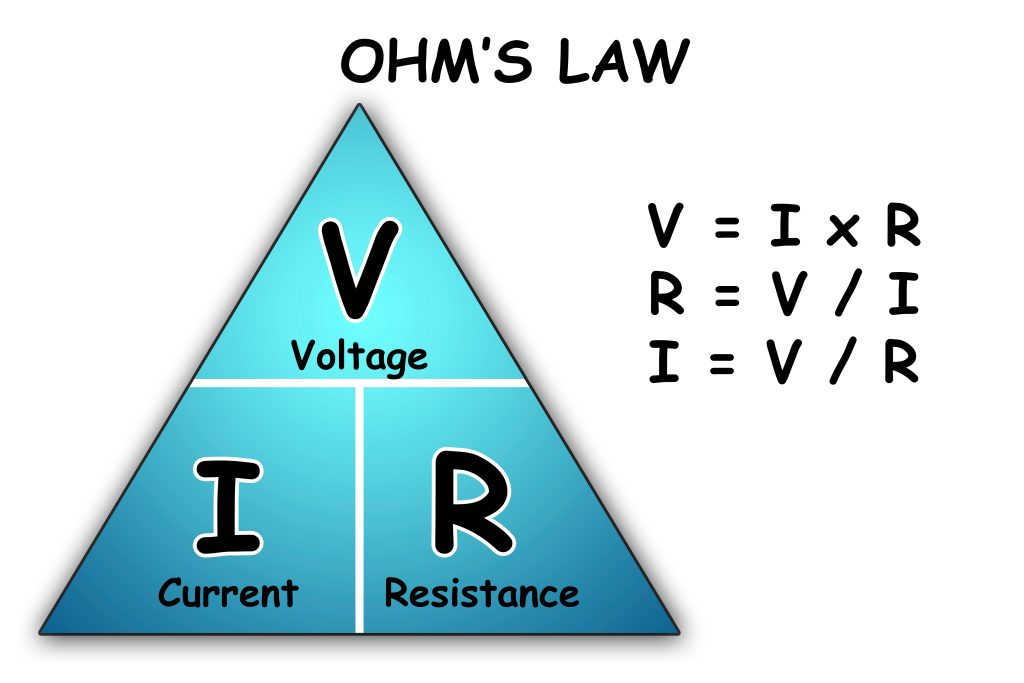
Ohm’s law describes how the current (I) varies with an applied voltage (U) and the resistance (R) over which the voltage is applied. Double the voltage gives double the current if the resistance is unchanged. Double the resistance gives half the current if the voltage is constant.
Practical Electrical Handling in Boats
It is a common misconception that a boat is charged with 14.4 volts. Because if we look at the charging circuit, we see the following:
As we know, the battery has its own voltage, a counter voltage. The back voltage is the voltage the battery shows if we measure it when we have just switched off the engine. The battery’s counter voltage takes out a large part of the alternator’s voltage, so we actually have about 14.2 – 12.5 = 1.7 V. So we have 1.7 volts available. That’s as much as a flashlight battery, but we still want fifty amps!
The maximum UG is determined by the alternator regulator (usually 14.1 – 14.4 V) and U is determined by the charge level of the battery.
If UG – UB are fixed values, we have to make sure that the internal resistance of the battery (RB) is low. If RB is low, we say that the battery’s charge receptivity is good. The resistance of the battery is determined by its chemical and physical structure. A starter battery has very good chargeability, a leisure battery slightly worse and a GEL battery has the worst chargeability.

No ideal circuit
The above reasoning assumes that all energy is transferred without loss from generator to battery and this is of course not possible. In practice, we are allowed to introduce a resistance to RK that represents the resistance in cables, couplings, diodes and the like.
Suppose we have a situation where the generator is at its maximum 14.2 V. It is still charging at 50 A, and the battery is half full, giving a back voltage of 12.8 V. The net voltage overcoming the battery RB is then 1.4 V. If the resistance in the cables and connections, RK, gives a voltage drop of 0.7 V, then only half, i.e. 0.7 volts, is left.
This is not an unreasonable assumption. Our measurements show that a standard divider diode can add a voltage drop of 0.7 volts on its own. Add some losses in cables and connections and it becomes clear that both the charging voltage and in turn the charging current can be more than halved.