


 En
 Sv
Which cables to choose
A boat’s electrical system places greater demands on cables and conductors than many land-based installations.
Vibration, moisture, salt, oil and temperature fluctuations make conductor construction, insulation, cross-sectional area and color identification important.
This guide explains what to choose and what to avoid when installing 12 V, 24 V and single-phase AC systems on boats, based on the requirements of the applicable standard for recreational craft. This is a European standard.
Which colors apply to AC (230 V alternating current) and DC (12 V, 24 V direct current, etc.)?
| Function | Permitted/specified colour | Important |
| DC positive (+) | Identified by colour or other clear marking | Black or yellow must NOT be used. |
| DC negative (−) | Black or yellow | If black is used as an AC live conductor, DC negative (-) shall be yellow. |
| DC equipotential bonding | Green or green/yellow; uninsulated strip or braid is also permitted | Shall not be used as a current-carrying conductor. |
| AC line, single-phase | Black or brown | Yellow, green or green/yellow shall not be used. |
| AC neutral, single-phase | White or light blue | Yellow, green or green/yellow shall not be used. |
| AC protective conductor | Green or green/yellow | Reserved for the protective conductor function. |
DC positive +
Identification methods other than insulation colour are permitted for DC positive, provided that the conductors are correctly identified in the boat’s wiring diagram. Black and yellow insulation shall not be used for DC positive.
DC negative −
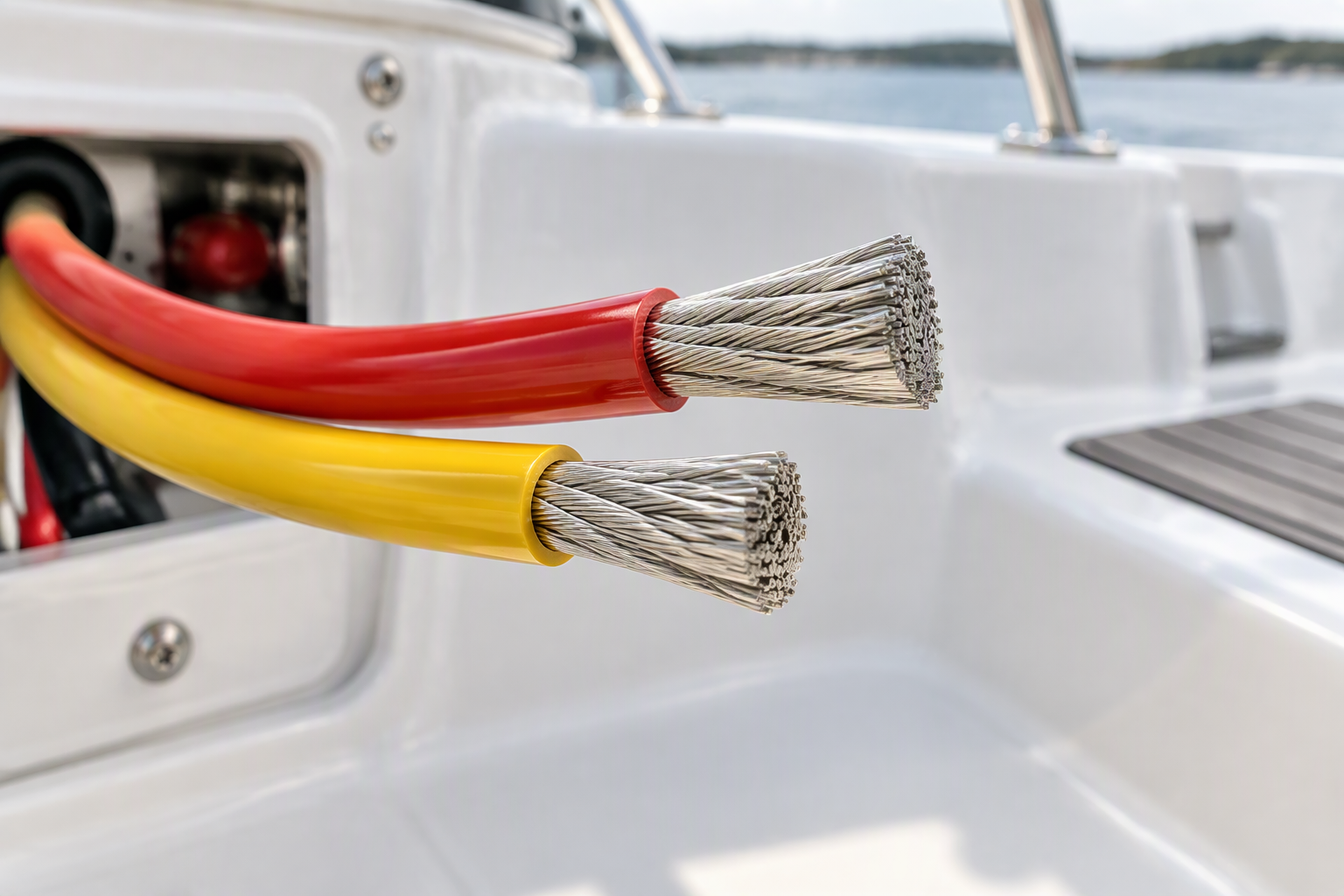
DC negative conductors shall be identified by black or yellow insulation. If the boat also has an AC system in which black is used as a live conductor, yellow must be used for DC negative.
In a boat with both AC and DC systems, yellow DC negative provides a clearer distinction when black is used as an AC conductor.
Avoid AC colors in DC systems
In boats with both AC and DC systems, brown, white and light blue insulation should be avoided in the DC system unless the conductors are clearly separated from AC conductors and identified as DC.
Sheathing and insulation
| Environment/system | Requirements according to the source material |
| DC distribution | Conductor insulation must be flame-retardant. |
| Engine compartment | Minimum temperature rating of 70 °C. Insulation must be oil-resistant or protected by insulating conduit or sleeving. |
| AC outside engine compartments | Minimum temperature rating of 60 °C. |
| AC conductors and flexible cords | Voltage rating of at least 300 V to 500 V, with stranded copper conductors. |
Distinguish between conductor insulation and any common outer sheath. The requirements must be met wherever the respective part is exposed to heat, oil, moisture or mechanical stress.
Minimum conductor cross-sectional area
Arrangement | Minimum cross-sectional area | Restriction/note |
Separately installed conductor | 1 mm² | Applies when the conductor is longer than 175 mm. |
Conductor in a multicore cable with a common sheath | 0.75 mm² | May extend no more than 800 mm beyond the outer sheath. |
Internal wiring in a distribution panel | 0.75 mm² | An exception. |
Please note: The minimum cross-sectional area is not automatically the correct cable size. The final cross-sectional area shall be selected based on the load, current-carrying capacity, and allowable voltage drop.
Feel free to use our cable calculator to find the correct cable size.
Keep AC and DC separate
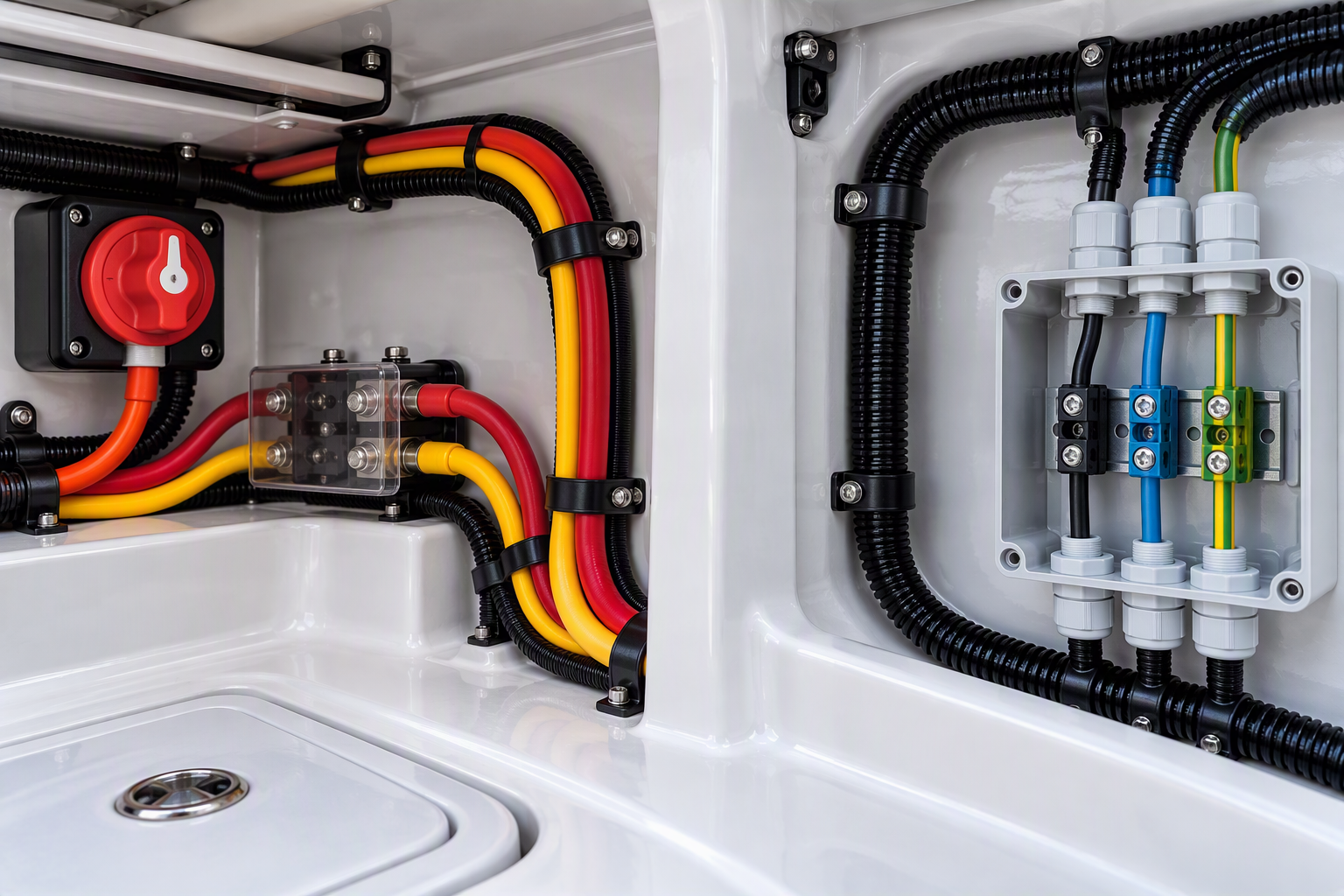
DC conductors shall not be installed in the same wiring system as AC conductors without an approved method of separation. Examples include:
- Separate cable ducts, conduits or protective sleeving
- Separate compartments within conduit or cable trunking
- A partition on a cable tray or cable ladder
- At least 100 mm separation where AC and DC conductors are secured directly to a surface
Cable routing and protection
Water
Current-carrying conductors shall be routed above areas where water may accumulate, such as bilges, and at least 25 mm above the level at which the automatic bilge pump switch activates. If wiring must be routed below the expected bilge water level, enclosure protection requirements apply, and no connection may be located below the foreseeable water level.
Heat
- At least 50 mm from water-cooled exhaust components
- At least 250 mm from dry exhaust components
- Shorter distances require equivalent thermal protection
Support and mechanical protection
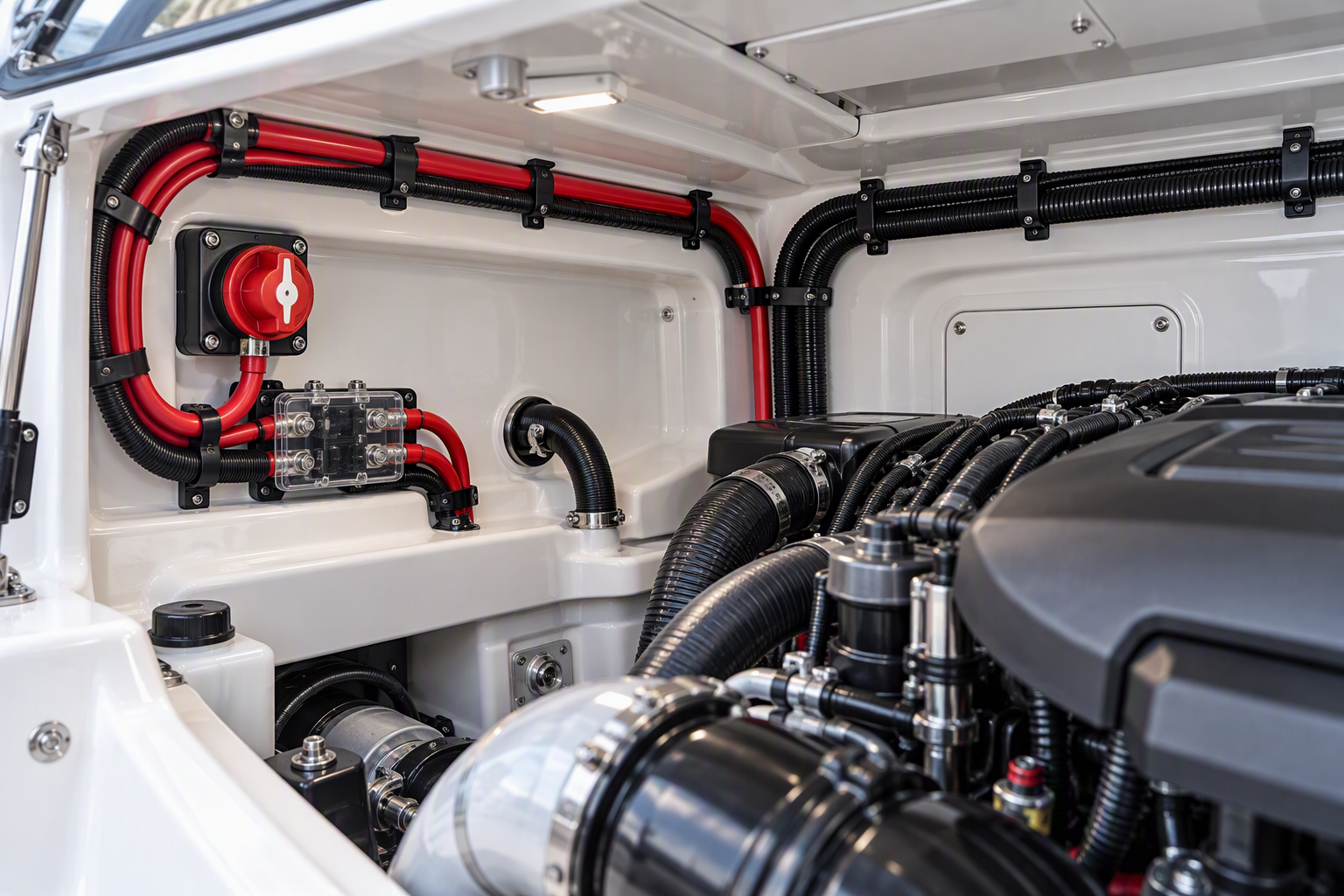
Conductors and cables shall be supported throughout their length in conduit, cable trunking or cable trays, or by individual supports spaced no more than 450 mm apart. Sheathed conductors and battery conductors up to the battery disconnect switch (main switch) shall be supported at intervals not exceeding 300 mm. Conductors that may be exposed to physical damage shall be protected by sheathing, conduit or equivalent protection.
Cables and methods that shall not be used
- Solid conductors
- Green or green/yellow conductors used as ordinary current-carrying conductors
- Black or yellow insulation used for DC positive
- DC insulation that is not flame-retardant
- Cables with an insufficient temperature rating or inadequate oil resistance in engine compartments
- Unprotected cable where physical damage may occur
- AC and DC wiring installed together without the required separation
- Twist-on wire connectors, commonly known as wire nuts
- Stripped conductor ends placed directly under bolted or screw connections
Use suitable terminals. Solderless crimp terminals and connectors must be fitted using a crimping tool designed for the connection concerned.
Check | Question to answer |
Conductor type | Is the conductor stranded copper? |
Insulation | Is it flame-retardant and suitable for the temperature, oil exposure and environment? |
Cross-sectional area | Is the cross-sectional area sufficient for both the current and the permissible voltage drop? |
Colour/marking | Can the function and system be identified without risk of confusion? |
Routing | Can the cable be protected against water, heat and physical damage? |
Separation | Can AC and DC be kept separate using an approved method? |
Sutars tip: The right cable, correctly sized and fitted with properly crimped cable lugs, makes the electrical system safer, easier to service and simpler to troubleshoot. |
Quick pre-purchase checklist
When selecting the cable size and length, the voltage drop shall not exceed 10%. To calculate the voltage drop in a cable, use our cable calculator.
We recommend always using tinned cables for installations in boats.
This helps prevent corrosion of the conductors, which can cause voltage drop, overheating and, in the worst case, fire.
In summary, we recommend always using yellow cable for DC negative. This prevents accidental confusion between 230 V and 12 V.
For DC (12/24 V), use yellow (−) and red (+). Do not use black, brown, white or light blue.
For AC (230 V), use black, brown, white and light blue, together with green/yellow for protective earth. Never use yellow or red.
In short: Use stranded tinned copper conductors with the correct cross-sectional area and insulation for the environment. Do not use green or green/yellow conductors as current-carrying conductors, and do not mix AC and DC wiring without the required separation.
This page summarises the applicable standard. Additional rules and exceptions apply depending on where and how you install the electrical system in your recreational craft.