FAQ Alternator questions
Frequently asked questions about alternator and charging systems
Not finding what you were looking for? Get in touch with us!
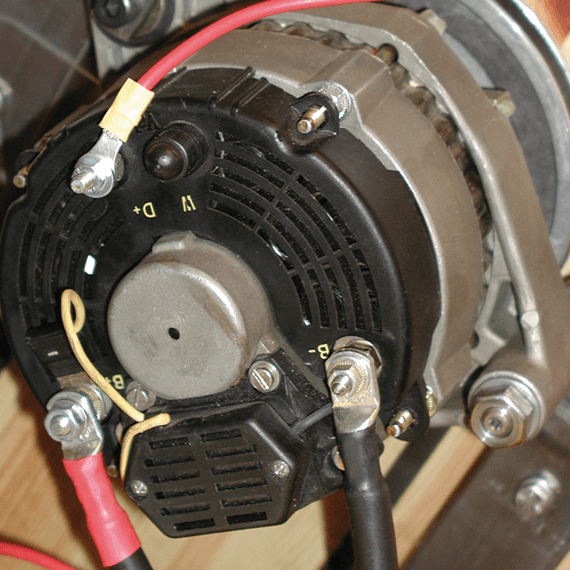
Why are there so many cables on my generator?
The alternator is often used as a bus bar.
The engine requires electrical power for both instruments and sensors.
The starter motor is frequently used as a bus bar for various electrical loads.
What if my generator has no B-?
If no B− terminal is provided, connect the negative cable directly to the alternator housing.
How does the generator regulate the charging voltage?
The alternator’s voltage regulator limits the maximum output voltage by controlling the amount of current flowing through the rotor field winding.
How many cables are needed to get power from the generator?
Three of them; B+, B- and D+.
Does the controller switch down to maintenance charging?
No, the alternator regulator cannot switch down to maintenance charging. The regulator’s job is to make sure that the alternator maintains 14.4 V.
Does the engine alternator regulate the charging?
No, the batteries regulate the charge themselves by constantly increasing the resistance to charge during the charging process.
What does the alternator governor control?
A 50 A alternator will overheat and fail if the current becomes significantly higher than 50 A.
For this reason, the alternator regulates the magnetization of the rotor to prevent this from occurring.
In addition, the voltage regulator limits the system voltage to typically no more than 14.4 V.
What is a TWC?
TWC is an alternator regulator designed to compensate for undesired voltage drop. Volvo Penta offers a corresponding unit. However, neither the TWC nor Volvo Penta’s equivalent can switch down to a maintenance/float charge mode.
How do I switch if I have a TWC controller?
Connect the sense wire from the regulator to the alternator B+ terminal, and run the cables from B+ and B− to the battery with a maximum total voltage drop of 0.1 V, as usual.
My alternator has no B-, what should I do?
Few alternators are true two‑pole units. Proper two‑pole alternators and starter motors are expensive.
However, make sure that the alternator is not mounted using rubber bushings for vibration isolation. If rubber isolators are used, it is possible to end up on the wrong side of the insulating bushings, resulting in no electrical ground connection at all.
How do I find D+?
Turn the ignition key on. Measure at the alternator: D+ must have voltage when the ignition key is ON, but no voltage when it is switched OFF.
More tips & tricks
Do you have another question?
Didn’t find the right answer to your question? Contact us via the form below and we will get back to you!