FAQ Generator questions
Frequently asked questions about generators and charging systems
Do you have questions about how your generator works, which cables are needed or how the charge controller affects the voltage? Here you will find answers to the most common questions about installing, connecting and maintaining generators. Whether you’re wondering about B, D+ or how to use a TWC regulator, we’ve gathered all the information you need.
Not finding what you were looking for? Get in touch with us!
- +46(0)8 664 34 00
Why are there so many cables on my generator?
The generator is often used as a terminal. The engine needs power for both instruments and sensors. The starter motor is often used as a terminal for various consumers.
What if my generator has no B-?
If B- is missing, fit the negative cable directly into the metal casing of the generator.
How does the generator regulate the charging voltage?
The generator governor limits the maximum voltage by regulating the amount of current passing through the magnetising winding of the rotor.
How many cables are needed to get power from the generator?
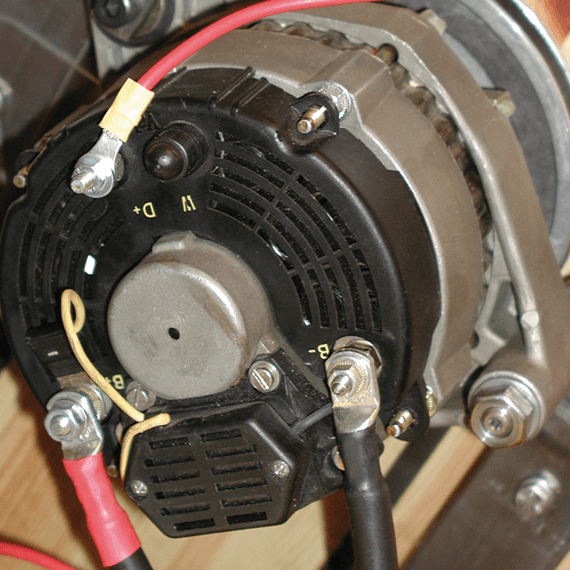
Three of them; B+, B- and D+.
Does the controller switch down to maintenance charging?
No, the alternator regulator cannot switch down to maintenance charging. The regulator’s job is to make sure that the alternator maintains 14.4 V.
Does the engine generator regulate the charging?
No, the batteries regulate the charge themselves by constantly increasing the resistance to charge during the charging process.
What does the generator governor control?
A 50 A generator will burn up if the current is significantly higher than 50 A. Therefore, the generator regulates the magnetisation of the rotor so that this does not happen. Furthermore, the regulator regulates the voltage to a normal maximum of 14.4 V.
What is a TWC?
TWC is a regulator for generators, which is intended to compensate for unwanted voltage drop. Volvo Penta has an equivalent. Neither TWC nor Volvo Penta’s equivalent can switch down to maintenance charging.
How do I switch if I have a TWC controller?
Connect the sensing lead from the regulator to the alternator B+ and wire the battery from B+ and B- with a maximum 0.1V voltage drop in total, as usual.
D+ the relay should click if and only if the ignition is switched on.
My generator has no B-, what should I do?
Few generators are two-pole. True two-pole alternators and starters are expensive. The most common is that B- is attached directly to the alternator casing. B- is then not isolated from the goods in the engine.
If you do not have a B-, you can use a screw on the alternator casing or one of the alternator’s fixing screws. Just check that the generator is not attached via rubber bushings for the sake of vibration. If it is, you can end up on the wrong side of the insulating rubber bushings if you do not look up and thus not make contact at all.
How do I find D+?
Switch on the ignition key. Measure the alternator, D+ should have voltage when the starter key is on but not when it is switched off.
Or you can connect one pin of the relay to the negative of the battery, put a cable on the other pin of the relay and test it against the different connections of the alternator. When you connect the cable to D+, the relay should click if and only if the ignition is switched on.
Can I use the Skyllermark 75 A isolating relay with my 115 A generator?
You can use it with a generator of up to 135 A. The 75 A breaking current is dimensioned for longevity and not survival.
If you use a 115 A alternator, the lifespan is slightly reduced from the 125,000 breaks promised by Bosch. But 125,000 breaks is one boat trip a day for 170 years…
More services we provide
Do you have another question?
Didn’t find the right answer to your question? Contact us via the form below and we will get back to you!