En
En  Sv
SvHow charged are my lead-acid batteries?
How to Interpret Battery Voltage and State of Charge
The size of your battery bank is measured in ampere-hours (Ah). This is a measure of how many hours you can draw a certain number of amperes from your batteries. If you have a battery bank of 200 Ah, you can theoretically draw 20 A for 10 hours. (Which only works in theory, since lead-acid batteries fail if subjected to too many deep discharges.)
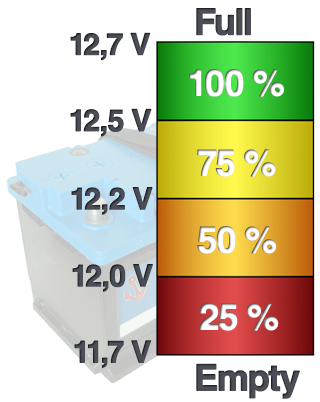
The table shows the voltage across the lead-acid batteries at different levels of discharge. The table applies to domestic batteries at rest or with very low consumption. A starter battery needs to rest for several hours after an engine start for the value to be reliable.
When you draw more current, add about 0.2 V to the instrument’s reading before comparison. That is, if your instrument shows 12.1 V under load, it should be read as 12.3 V.
Note that the table is approximate, but after a while you will get to know your lead-acid batteries. A fuel gauge is not exact either, but it still provides peace of mind. If you have a battery monitor that uses current measurement to estimate the state of charge, you should still keep an eye on the voltage, since voltage never drifts over time.