


 En
En  Sv
SvBattery care
A guide to battery care. Give your battery better performance and a longer lifespan.
Storage
During long-term storage, the battery should be disconnected from the electrical system. Even very small currents (connected clocks, alarms, etc.) will discharge the battery and, over time, cause damage.
Make sure the battery is fully charged when it is put away for storage.
Store the battery in a cool (frost-free) and dry place, as self-discharge is halved for every 10-degree drop in temperature.
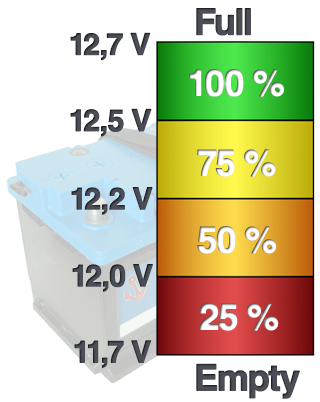
All batteries have a certain level of self-discharge, which is evident as the open-circuit voltage drops. If the voltage falls below 12.4 V, the battery must be charged. Batteries that are not kept fully charged risk sulfation and loss of capacity.
Remember that a discharged battery can freeze and crack at normal winter temperatures.

Maintenance and operation
Batteries must be securely mounted and have good ventilation.
Batteries work best at room temperature. Heat and cold impair battery performance.
Keep terminals and cable lugs clean from deposits.
Keep batteries clean and dry, as moisture and dirt can lead to small currents (leakage currents) on the top of the battery and increase self‑discharge.
For flooded batteries, the electrolyte level (acid) should be checked regularly and, if necessary, adjusted with distilled water.
Batteries should not be deeply discharged. Repeated deep discharges significantly shorten battery lifespan.
The open‑circuit voltage of batteries provides an indication of the state of charge: (After charging, batteries need to rest for atleast a day so that the voltage has time to stabilize before the open‑circuit voltage is measured.)
Charging
Self‑discharge in modern batteries is low, but batteries at rest will nevertheless always slowly lose charge. This must be compensated either by charging the battery at certain intervals or by continuous maintenance charging.
It is important to choose a charger that is suited to the battery being charged.
A modern battery charger is characterized, among other things, by having:
• Temperature compensation (the charger adjusts the charging voltage according to temperature).
• A charging profile adapted to the battery technology – AGM/GEL or Standard (flooded batteries with liquid electrolyte).
• Charging adapted to the battery’s size (capacity in Ah).
