


 En
En  Sv
SvLoad test for your battery bank
How to perform a load test on your battery bank
With the right instruments, it is easy to measure the batteries’ voltage. The voltage indicates how charged your batteries are, but not how large your battery bank is. To find that out, you must perform a load test.
The size of your battery bank is measured in ampere-hours (Ah). It is a measure of how many hours you can draw a certain number of amperes from your batteries. If you have a 200 Ah battery bank, you can draw 20 A for 10 hours. This applies in theory. How much you can draw without damaging your batteries depends on what type of batteries you have.
You perform a load test to check how many Ah your battery bank holds. Especially if the batteries are a few years old, it can be a good idea to do this to determine how much capacity remains in them.
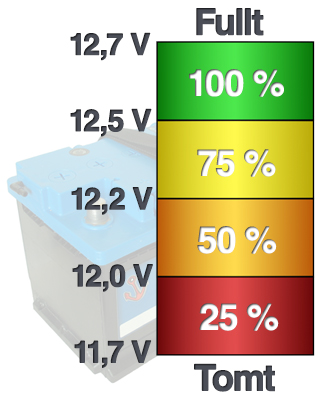
This is how the test is performed
1. This is how the test is performed.
The test is carried out by first fully charging your batteries, then switching on loads and checking how long it takes before your batteries are half discharged.
2. Full discharge and recommendations
It is possible to measure this by fully discharging your batteries, but we recommend that you avoid doing so in order not to cause unnecessary wear on the batteries.
3. Checking the voltage
To know what voltage corresponds to full and half charge of your batteries, we look at the voltage table on the right. We see that the batteries are fully charged at 12.7 V and half discharged at 12.2 V. So the first step is to make sure that your batteries are fully charged and that the voltage is at least 12.7 V.
4. Switch on the consumers
Once that is done, it is time to turn on the consumers. Be sure to check how many A your consumers draw (preferably measure with a clamp ammeter).
5. Start the clock and wait
Start the timer. Then it’s just a matter of waiting. We want to know how long it takes before your measuring instrument shows 12.0 V.
6. Adjustment of measured value
No, we have not written it incorrectly. Remember that under load you must add 0.2 V to the value you read on your measuring instrument to get the correct voltage. 12.0 V on the instrument therefore corresponds to 12.2 V in the batteries when you are drawing power.
7. Measure time and calculate capacity
When the voltage in the batteries is 12.2 V, you check the time. Then take the time and multiply it by your consumption.
8. Final calculation
Time (h) x Consumption (A) = Ah
Now we know how many ampere-hours are available if you only want to discharge your batteries to half. Double the figure you have obtained if you want to know how much is available until your batteries are fully discharged.
See the calculation
Time (h) x Consumption (A) = Ah
Belastningstest
Tid X Förbrukning (h x A)
What is the most I can use from my battery bank without destroying my batteries?
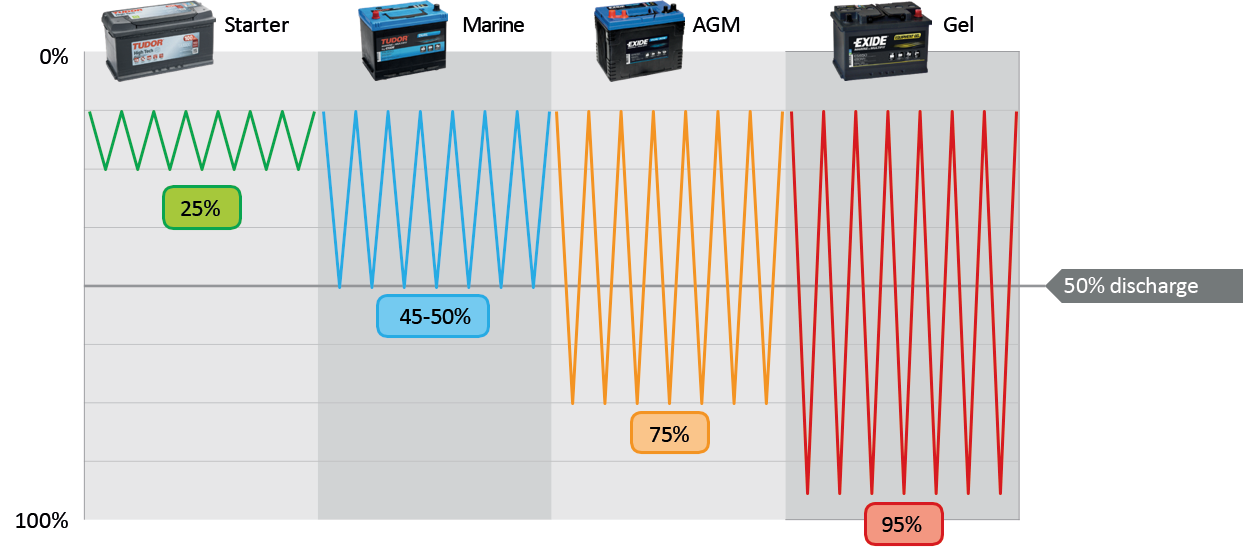
* This is a general diagram of battery discharge. Always follow the recommendations of the respective manufacturer.